ICD-10 and clinical diagnosis
ICD-10 diagnosis codes for venous disease
A CEAP code describes venous disease structure, while ICD-10 groups help formalize the clinical diagnosis for varicose veins and related venous disorders. PhleboCEAP keeps both parts close together.
PhleboCEAP
Clinical diagnosis inside the app
PhleboCEAP combines ICD-10 groups, venous signs, CEAP codes, and the final text conclusion in one iPhone and iPad workflow.
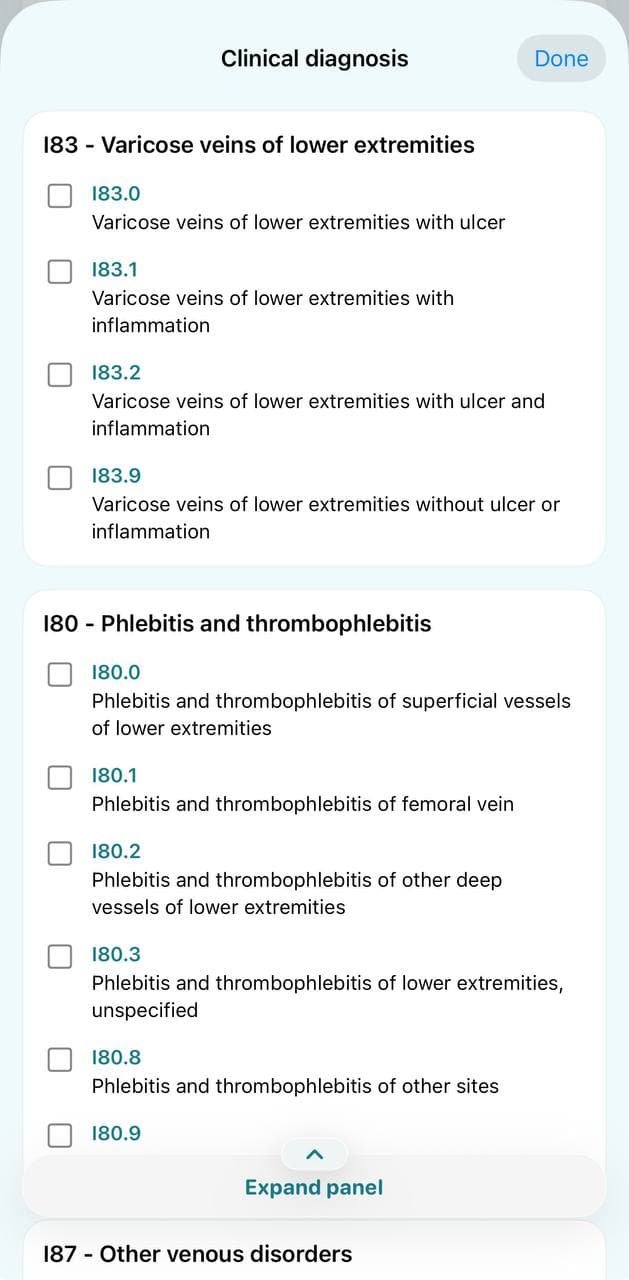
I83 varicose veins of lower extremities
The I83 group is commonly used for varicose veins of the lower limbs, including variants with ulceration, inflammation, both ulceration and inflammation, or without either finding.
I80 phlebitis and thrombophlebitis
The I80 group helps describe phlebitis and thrombophlebitis scenarios, including superficial vessels, femoral vein, other deep vessels, or unspecified localization.
I87 other disorders of veins
The I87 group can be used for selected chronic venous disorders and related venous diagnoses when the clinical conclusion requires a broader code family.
From structured fields to readable text
PhleboCEAP combines selected ICD-10 codes, clinical signs, CEAP coding, and venous disease options into a text conclusion. Copy the CEAP code alone or the full result, then share either version through iOS.
Frequently Asked Questions
Which ICD-10 groups does PhleboCEAP support?+
The clinical diagnosis module supports I83, I80, and I87 groups for varicose veins, phlebitis, thrombophlebitis, and related venous disorders.
How does ICD-10 relate to CEAP?+
CEAP describes the venous disease structure, while ICD-10 helps formalize the clinical diagnosis text and code family.
Can the generated diagnosis be copied?+
Yes. PhleboCEAP lets you copy the CEAP code alone or the full result with diagnosis wording and share either version through iOS.
Also useful for this topic
Keep CEAP coding close to the clinical workflow.
PhleboCEAP brings Basic, Advanced, and Advanced+ CEAP-2020 coding, NK 025:2021 / ICD-10-AM diagnosis, rVCSS, VSDS, and VDS scoring, and flexible sharing into one iPhone and iPad tool.

PhleboCEAP is a documentation aid for clinicians. It helps prepare CEAP codes and diagnosis wording, but it does not replace clinical judgment or the physician's responsibility for the final diagnosis.