CEAP app for iPhone and iPad
CEAP classification app for vascular surgeons
PhleboCEAP is a CEAP classification app built for vascular surgeons who need fast, structured documentation of chronic venous disease, varicose veins, and related clinical diagnoses.
PhleboCEAP
A compact clinical workflow
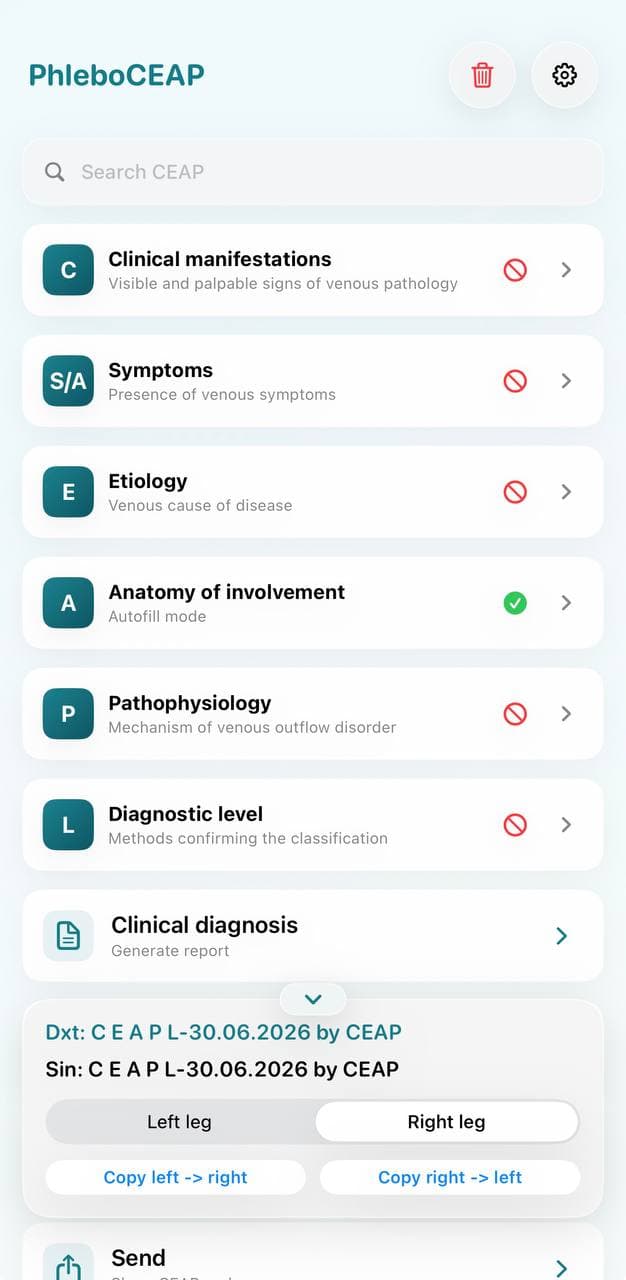
Choose a CEAP mode, code the right and left legs separately, use built-in or custom templates, add rVCSS, VSDS, and VDS scoring, and copy either CEAP alone or the full result before sharing through iOS.
Basic, Advanced, and Advanced+ workflows
Choose a concise Basic CEAP record, detailed Advanced CEAP coding with venous segments, or Advanced+ with clinical diagnosis and CVD scoring modules.
Bilateral documentation for Dxt and Sin
Right and left legs can be coded separately, which is important when venous disease is asymmetric or when one limb needs a different clinical description.
Templates for common venous scenarios
Start with built-in CEAP scenarios or save a reusable custom template directly from the current result.
From classification to clinical text and scoring
PhleboCEAP connects CEAP-2020, NK 025:2021 / ICD-10-AM, the Saveliev classification, and separate rVCSS, VSDS, and VDS assessment for each limb.
Frequently Asked Questions
Who is the CEAP classification app for?+
PhleboCEAP is designed for vascular surgeons and clinicians who document chronic venous disease and need a structured CEAP-2020 workflow on iPhone or iPad.
Does the app support ICD-10 diagnosis text?+
Yes. It supports clinical diagnosis wording with ICD-10 groups I83, I80, and I87 for venous disease scenarios.
Is PhleboCEAP available in the App Store?+
Yes. Version 1.1.0 is available for iPhone and iPad: https://apps.apple.com/app/phleboceap/id6777989927
Also useful for this topic
Keep CEAP coding close to the clinical workflow.
PhleboCEAP brings Basic, Advanced, and Advanced+ CEAP-2020 coding, NK 025:2021 / ICD-10-AM diagnosis, rVCSS, VSDS, and VDS scoring, and flexible sharing into one iPhone and iPad tool.

PhleboCEAP is a documentation aid for clinicians. It helps prepare CEAP codes and diagnosis wording, but it does not replace clinical judgment or the physician's responsibility for the final diagnosis.